
Do I Need an Internal, External, or Web App Pen Test?
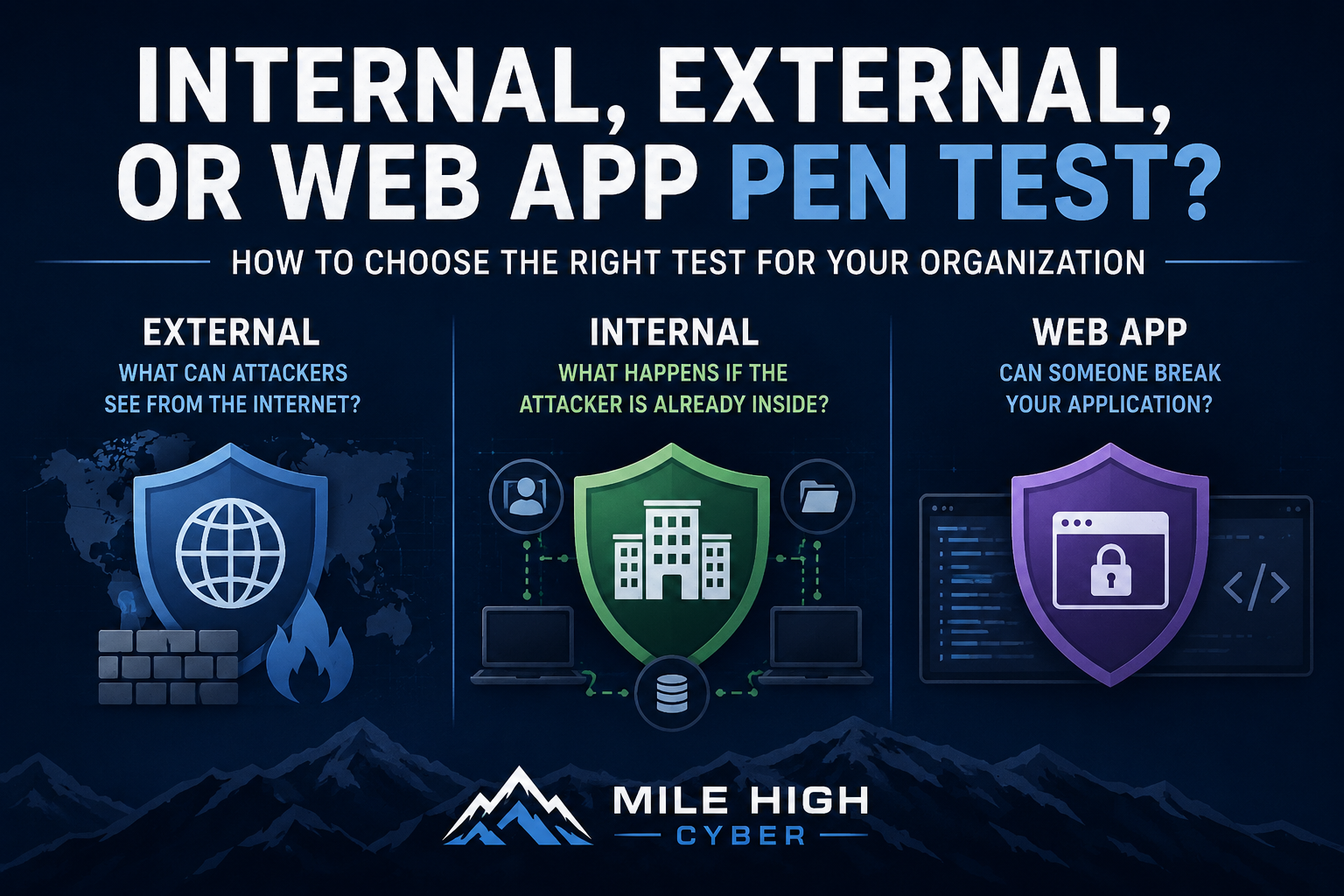
One of the most common questions we hear is, “What kind of pen test do we actually need?”
It’s a reasonable question. Most organizations know they need some kind of security testing, either because a customer asked for it, cyber insurance requires it, or they simply want to understand their risk. But the terminology can get confusing quickly. Internal, external, web application — they all sound similar, but they answer different security questions. We work through this question with clients across Colorado all the time, from Denver to Colorado Springs, and the right starting point almost always comes down to what you’re actually trying to protect.
External Pen Test
An external penetration test looks at what an attacker can see from the internet. This usually includes things like firewalls, VPNs, remote access systems, public IP addresses, cloud-hosted services, and anything else exposed outside the organization.
This type of test helps answer questions like:
What can an attacker find about us from the internet?
Do we have exposed systems or services we forgot about?
Could someone break into our environment from the outside?
For many small and midsize businesses, this is the most logical place to start because it focuses on the part of the environment most visible to attackers.
Internal Pen Test
An internal penetration test asks a different question: what happens if the attacker is already inside?
That could happen through phishing, stolen credentials, a compromised laptop, or a vendor account. Once inside, an attacker may try to move through the network, elevate privileges, access sensitive data, or reach critical systems.
An internal test is useful when you want to understand:
Whether one compromised device could turn into a bigger incident
How easily an attacker could move across the network
Whether sensitive systems and data are properly protected
Internal testing is especially useful for understanding ransomware risk because it shows whether a single foothold could become an organization-wide problem.
Web Application Pen Test
A web application penetration test is more focused. Instead of looking broadly at your network, it looks deeply at a specific application, customer portal, API, or SaaS platform.
This type of test is important when:
Users log into an application
Sensitive customer, employee, financial, or health data is processed
The application is central to your business or provided to customers
A network may be well protected while the application itself still has serious security flaws. Web app testing helps find issues like broken access controls, authentication problems, insecure APIs, and ways an attacker might access data or functionality they should not be able to reach.
So Which One Do You Need?
The right test depends on what you are trying to learn.
If you want to understand your internet exposure, start with an external test. If you are worried about what would happen after a phishing attack or ransomware foothold, an internal test makes sense. If your business depends on a customer-facing application or API, a web app test should be strongly considered.
A simple way to think about it:
External testing asks, “Can someone get in from the internet?”
Internal testing asks, “What happens if someone gets inside?”
Web application testing asks, “Can someone break or abuse this application?”
Sometimes the answer is more than one. An external test can show whether an attacker can get in. An internal test can show what they could do next. A web application test can show whether your software can be abused to access data or functionality.
The important thing is not to buy the wrong test just because the terminology is confusing. A quick scan is not the same thing as a human-led penetration test, and a network test is not the same thing as application testing.
If you’re not sure what you need, that’s normal. Many organizations come to us simply saying, “Our customer asked for a pen test. Can you help?” That’s a perfectly good place to start.
At Mile High Cyber, we help clients choose the right level of testing based on their actual risk, budget, and business needs.
Need help figuring out the right test? Let’s talk: https://www.milehighcyber.com/contact-us
Terry Bradley, CISSP, is the President and Founder of Mile High Cyber, with over 30 years of experience in cybersecurity. A CISSP since 2008, he specializes in penetration testing, vulnerability management, and virtual CISO services, helping small and mid-sized organizations identify, remediate, and verify their most critical security risks.