
How Much Does a Pen Test Cost in 2026?
One of the first questions we get from new clients is:
“How much does a penetration test cost?”
The honest answer is: it depends.
That is not always a satisfying answer, especially if you are trying to build a budget, respond to an auditor, satisfy a customer security questionnaire, or meet a cyber insurance requirement. We hear this question constantly from businesses across Colorado, whether they’re in Denver, Colorado Springs, or a smaller town in between.
So here is a more practical answer.
In 2026, many small and mid-sized businesses should expect a professional penetration test to cost somewhere between $4,000 and $15,000, depending on the type of test and the scope.
A small external-only test may be near the lower end of that range. An internal network test, web application test, segmentation test, or more complex compliance-driven engagement can cost more.
The goal is not to buy the biggest test possible. The goal is to buy the right test for the risk question you are trying to answer.
Typical Pen Test Pricing in 2026
These are realistic planning ranges for many small and mid-sized organizations:
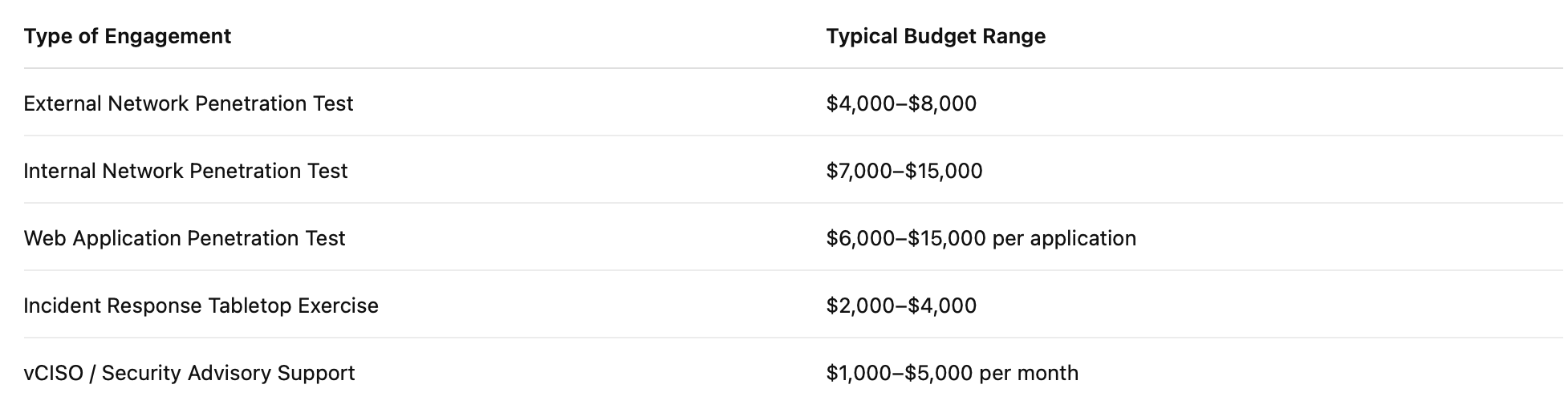
These are not universal prices. A very small, focused test could be less. A large or complex environment could be more. But these ranges are a good starting point for budgeting.
Why Does Pricing Vary So Much?
The biggest driver of cost is scope.
A penetration test is not a one-size-fits-all service. Two companies may both say they need a “pen test,” but the actual work may be very different.
A good scoping conversation usually answers questions like:
What are we testing?
How many systems are in scope?
Are we testing from the internet or from inside the network?
Are there web applications or APIs?
Is authentication required?
Is this for SOC 2, HIPAA, PCI DSS, cyber insurance, a customer request, or general risk reduction?
Do you need retesting or a formal readout?
Once the scope is clear, the pricing becomes much easier to understand.
External Network Penetration Test
An external penetration test looks at what your organization exposes to the internet.
This can include public IP addresses, domains, VPN portals, firewalls, web servers, cloud-hosted systems, and other internet-facing services.
For many organizations, this is the best place to start. Attackers usually begin with what they can see from the outside.
An external test is often a good fit when:
You need a first-time penetration test
A customer or partner is asking for security testing
Cyber insurance is asking about testing
You want to understand your internet-facing risk
You have a limited budget and need a practical starting point
Typical budget range: $4,000–$8,000
Internal Network Penetration Test
An internal penetration test looks at what could happen if an attacker gets inside your network.
That could happen through phishing, stolen credentials, a compromised laptop, or a malicious device connected to the network.
Internal testing often focuses on Active Directory weaknesses, privilege escalation, lateral movement, credential exposure, weak passwords, misconfigured file shares, and paths to sensitive systems.
This type of test is especially useful if your main concern is ransomware or business disruption.
Typical budget range: $7,000–$15,000
Web Application Penetration Test
A web application penetration test focuses on a specific application, portal, API, or SaaS platform.
This is different from a general external network test.
A web app test looks for issues like broken access control, authentication weaknesses, SQL injection, cross-site scripting, insecure file uploads, API authorization flaws, tenant isolation problems, and business logic issues.
If your company builds or operates a customer-facing application, this may be the most important test you can do.
Typical budget range: $6,000–$15,000 per application
The price depends heavily on complexity. A simple application with one user role is very different from a multi-role SaaS platform with APIs, file uploads, admin functions, and sensitive customer data.
What About SOC 2?
SOC 2 does not automatically mean “you need a web application pen test.”
For some companies, a web application test is the right answer. For others, the right scope may be an external network test, internal network test, cloud security review, Microsoft 365 assessment, or some combination.
The key question is:
What systems are included in your SOC 2 scope, and what controls are you relying on to protect customer data?
Compliance tells you why testing is needed.
Scope determines what kind of testing is needed.
That distinction matters because buying the wrong test can leave you with a report that does not actually answer the auditor’s, customer’s, or board’s real question.
What Makes a Pen Test More or Less Expensive?
A test usually costs less when the scope is small and clear.
Examples include a small number of external IPs, one clearly defined application, no complex authentication, no internal testing, and simple reporting needs.
A test usually costs more when there are multiple locations, internal network access, Active Directory testing, multiple applications, APIs, cloud environments, segmentation requirements, social engineering, strict testing windows, or multiple retest cycles.
None of that is good or bad. It just changes the level of effort.
Be Careful With the Cheapest Option
A lower-cost test can be appropriate when the business need is narrow.
The problem is not low price by itself.
The problem is paying for a test that does not answer the risk question.
If you are worried about ransomware, an external-only test may not tell you enough about internal lateral movement.
If your customer is concerned about your SaaS application, a basic network test may miss the application logic issues they care about.
If your auditor wants evidence around systems in your SOC 2 boundary, testing systems outside that boundary may not help much.
A good provider should help you right-size the engagement, not just sell you the biggest option.
Vulnerability Scan vs. Penetration Test
A vulnerability scan uses automated tools to identify known vulnerabilities, missing patches, exposed services, and configuration issues.
A penetration test goes further. It uses human analysis to validate risk, chain issues together, and determine what an attacker could actually do.
Both are useful.
Vulnerability scanning is good for ongoing security hygiene. Penetration testing is better for answering the question:
“What could an attacker actually do?”
For many organizations, the best approach is a combination of recurring vulnerability scanning and periodic human-led penetration testing.
How to Prepare for a Quote
You do not need perfect documentation, but it helps to gather a few details.
For an external test, gather domains, public IP ranges, known internet-facing systems, and anything you want excluded.
For an internal test, gather the number of locations, approximate number of users and endpoints, whether Active Directory is in use, and any sensitive systems you are most concerned about.
For a web application test, gather the application URL, number of user roles, whether there is an API, whether test accounts can be provided, and whether testing will happen in production or staging.
For compliance-driven testing, share the requirement, deadline, and any specific language from the auditor, customer, insurance carrier, or regulator.
That information is usually enough to provide a realistic estimate.
So, How Much Should You Budget?
For many small and mid-sized organizations, a good planning number is:
$4,000–$8,000 for an external penetration test
$7,000–$15,000 for an internal penetration test
$6,000–$15,000 for a web application penetration test
The right test depends on the question you are trying to answer.
Can an attacker break in from the internet?
What happens if one workstation is compromised?
Can one customer access another customer’s data?
Are we meeting a customer, auditor, or insurance requirement?
Are we doing enough to protect sensitive systems and data?
Once you know the question, the scope becomes clearer.
And once the scope is clear, the pricing becomes much less mysterious.
At Mile High Cyber, our goal is to help organizations right-size penetration testing so they get useful security insight without paying for work they do not need.
If you are trying to budget for a penetration test in 2026, we are happy to help you think through the right scope. A short scoping conversation is usually enough to determine whether you need an external test, internal test, web application test, cloud assessment, or something more focused.
Terry Bradley, CISSP, is the President and Founder of Mile High Cyber, with over 30 years of experience in cybersecurity. A CISSP since 2008, he specializes in penetration testing, vulnerability management, and virtual CISO services, helping small and mid-sized organizations identify, remediate, and verify their most critical security risks.